

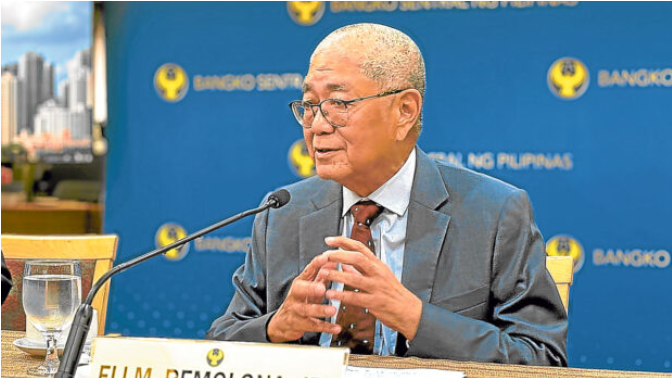
Eli Remolona Jr. —CONTRIBUTED PHOTO
MANILA, Philippines — The Bangko Sentral ng Pilipinas (BSP) raised its policy rate by half a percentage point to 5.5 percent on Thursday, delivering a bigger-than-expected increase as it stepped up its fight against stubbornly high inflation.
The decision by the Monetary Board, the central bank’s top policymaking body, brought the overnight borrowing rate to its highest level since February 2025.
It was the BSP’s fourth rate increase this year, bringing cumulative hikes since April to 125 basis points.
Only two of the 20 economists polled by the Inquirer had correctly predicted the move.
Speaking to reporters, Gov. Eli Remolona Jr. admitted that the BSP was “kind of” behind the curve despite its previous tightening actions.
He added that the central bank remains open to raising rates further.
“I think it [monetary policy] is restrictive, but we don’t know for sure whether it’s restrictive enough,” he said. “So, we’ll have to see. We’ll have to see whether inflation begins to slow down.”
Higher interest rates make borrowing more expensive, prompting households and businesses to curb spending and investment.
By cooling demand, the BSP aims to ease pressure on prices and prevent too much money from chasing too few goods.
But tighter monetary policy also threatens to weigh on an economy already struggling to gain momentum.
The Philippines grew by just 2.6 percent in the first half of the year.
READ: BSP urged to consider jumbo rate hike as inflation risks mount
The decision came weeks after inflation surged to 7.2 percent in September, its highest level in three years and well above market expectations.
Elevated oil prices and food supply disruptions caused by heavy monsoon rains fueled the increase.
The BSP expects inflation to average 6.1 percent this year, considerably above its 3-percent target.
It further raised its inflation forecast for 2027 to 6 percent from 5.4 percent, though it expects price growth to ease to 3.3 percent in 2028.
“The numbers we were looking at the forecasts were worse than we thought,” Remolona said. “So, there was a bit of a sense of urgency to try to dampen these inflationary pressures.”
READ: Poll: BSP seen raising rates again
The weakening peso has added to the challenge. Expectations of a hawkish US Federal Reserve have helped bolster the dollar, putting pressure on currencies around the world, including the Philippine peso, which has weakened beyond 63 to the dollar.
Remolona said policymakers had deliberately avoided delivering the outsized increase at an unscheduled meeting to prevent rattling financial markets.
“When you do [an] off-cycle [decision], it’s a little bit more desperate than before, and that’s not the message we wanted to convey,” he added.
Miguel Chanco, chief emerging Asia economist at Pantheon Macroeconomics, said another consecutive rate increase at the Dec. 17 meeting of the BSP was not a done deal despite the central bank’s hawkish rhetoric on inflation.
“Incidentally, today’s larger-than-expected adjustment could’ve been motivated as a front-loading of what would’ve been another uncontroversial 25 basis point hike in the last sit-down of this year,” Chanco said.
Jason Tuvey, deputy chief emerging markets economist at Capital Economics, said the BSP’s tightening cycle might be over.
